
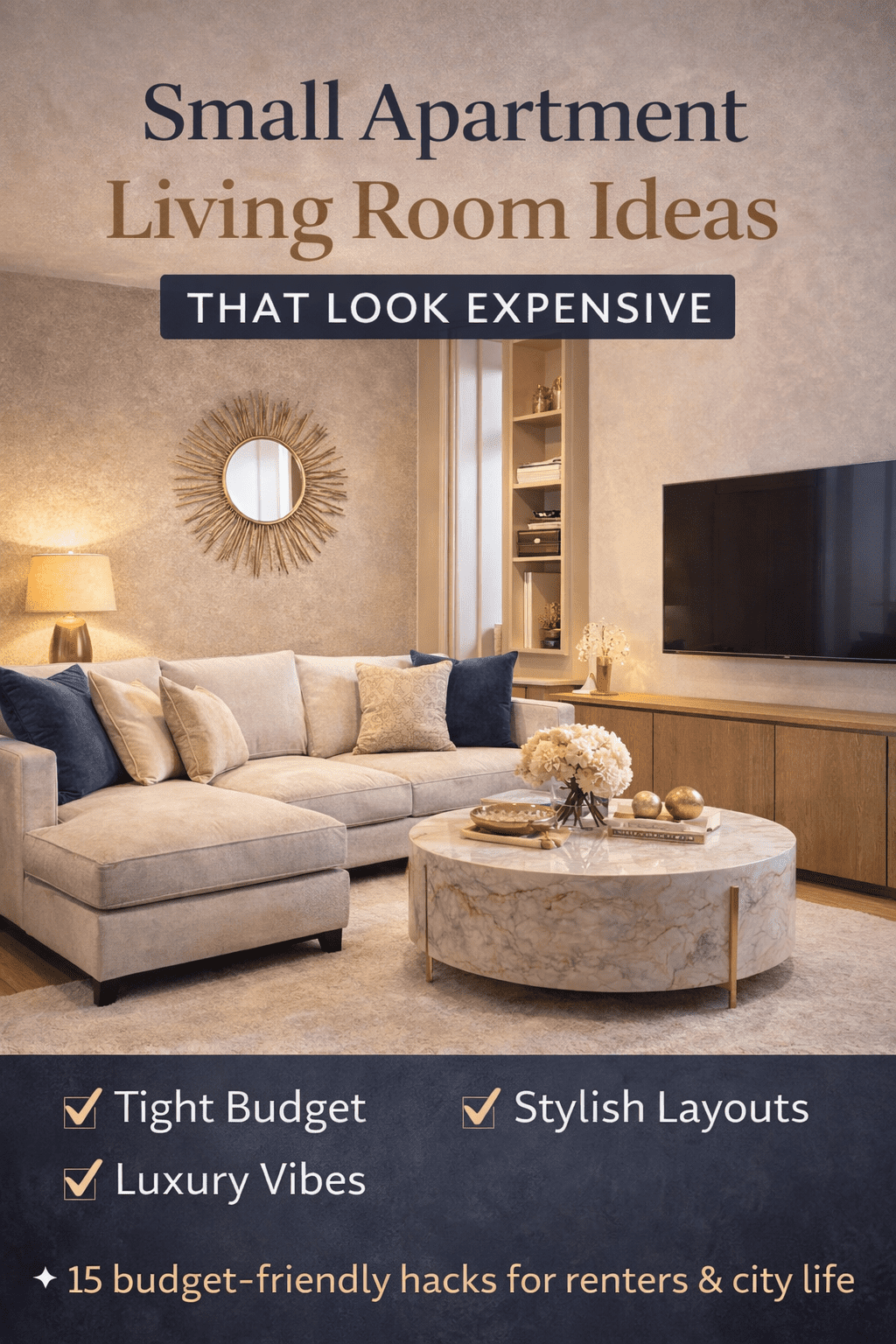
Designing a small apartment living room is no longer about compromise—it’s about smart, intentional design. In 2026, the focus has shifted toward warm minimalism, multifunctional furniture, and space-enhancing layouts that make even the smallest rooms feel open and luxurious. By combining clever storage solutions, light color palettes, and layered textures, you can transform a compact living space into a stylish and functional area that feels much larger than it actually is.
You’ll find ideas that work on a tight budget, layouts that maximize every inch, and modern design principles that make your small living room look like something straight off Pinterest — without the designer price tag.
01 — Foundation
Choose a Neutral & Warm Color Palette
The single fastest way to make a small apartment living room look expensive is to commit to a cohesive, warm neutral palette. Not white-white — that reads as clinical and cold. Instead, reach for warm whites, linen, soft greige, cream, and warm taupe. These tones visually expand a small room because the eye doesn’t stop sharply at any one surface.
Keep your walls, sofa, and large furniture pieces in the same tonal family. Introduce interest through texture and material — not contrasting color — and the room will feel sophisticated and spacious simultaneously.
Paint the ceiling the same color as the walls (or one shade lighter). It removes the visual “lid” from the room and creates an airy, loft-like feel — one of the most effective tricks designers use in small spaces.
02 — Strategy
Start with a Smart Small Apartment Living Room Layout
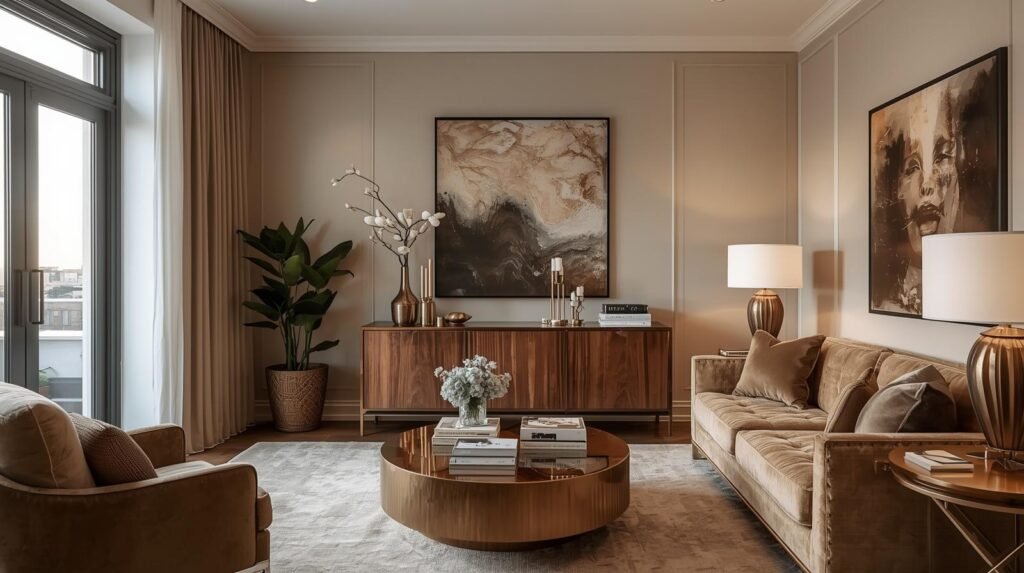
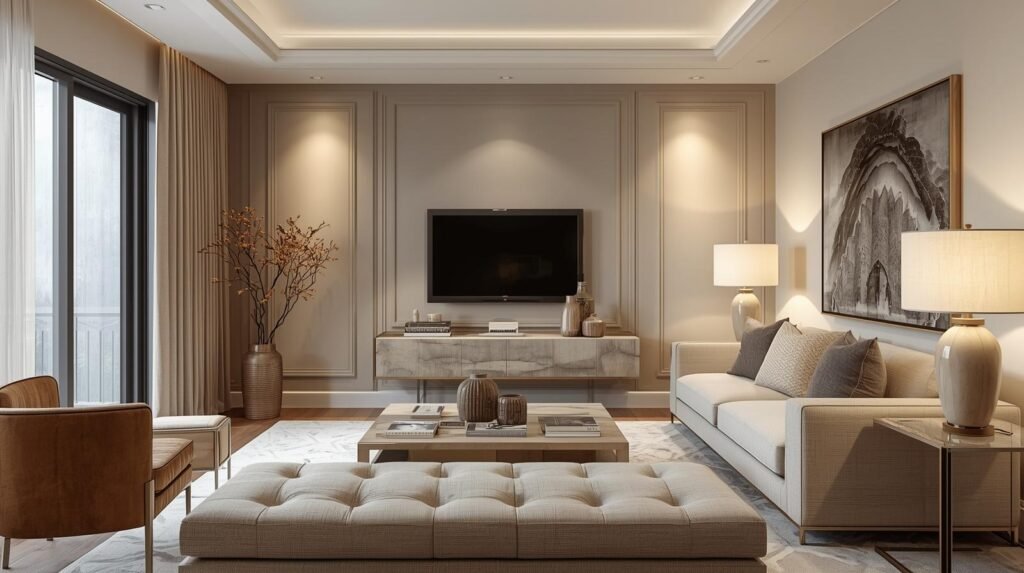
Left: A floating sofa arrangement that creates breathing room. Right: Very small living room layout styling using a defined seating zone.
Layout is the most powerful tool available in a small room — and the most underused. The first rule: pull furniture away from the walls. It sounds counterintuitive, but floating furniture creates a more intentional, sophisticated arrangement than pushing everything to the perimeter. For a very small living room, try this proven layout formula:
Keep traffic paths clear at 30–36 inches minimum. When you can walk through a compact room without feeling squeezed, it reads as designed — not cramped.
“In a small living room, a well-thought layout does more than square footage ever could. The arrangement is the design.”
03 — Centerpiece
Choose the Right Sofa for a Small Living Room
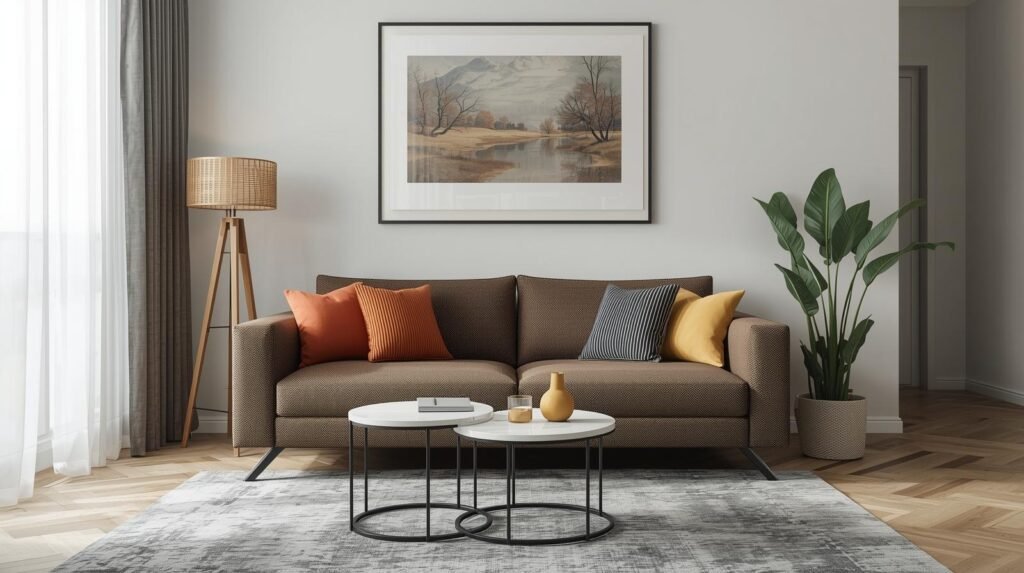
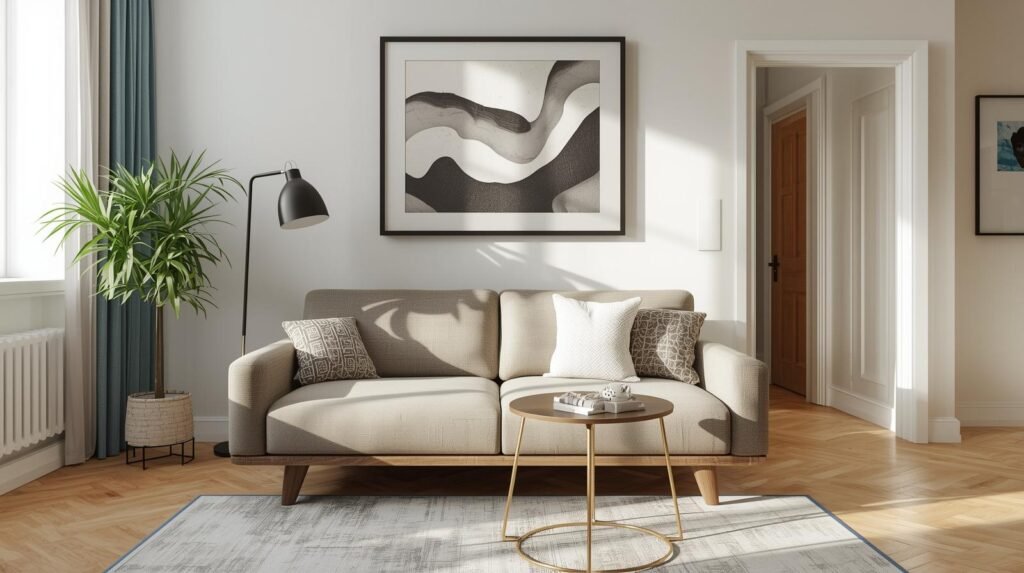
The sofa is the dominant piece in any living room. In a small space, the wrong sofa dominates in all the wrong ways. Here is what you should look for:
-
Low/mid-height back: Keeps sightlines open and the room feeling airy.
-
Exposed or tapered legs: Exposes the floor beneath to visually expand the room.
-
Neutral upholstery: Cream, warm beige, light gray, or camel — these disappear into the room and feel expensive.
-
Compact depth: A 34–36″ seat depth is ideal — deep enough to be comfortable, shallow enough not to swallow the room.
Consider a loveseat + accent chair instead of a full three-seater. Alternatively, select a small L-shaped sectional positioned in a corner — it provides generous seating while defining the zone without blocking flow.
04 — Smart Living
Invest in Multifunctional Furniture
This is the secret weapon of every well-designed small apartment living room on a budget. When a single piece does two or three jobs, you eliminate the clutter of extra furniture — and the room instantly looks cleaner and more considered.
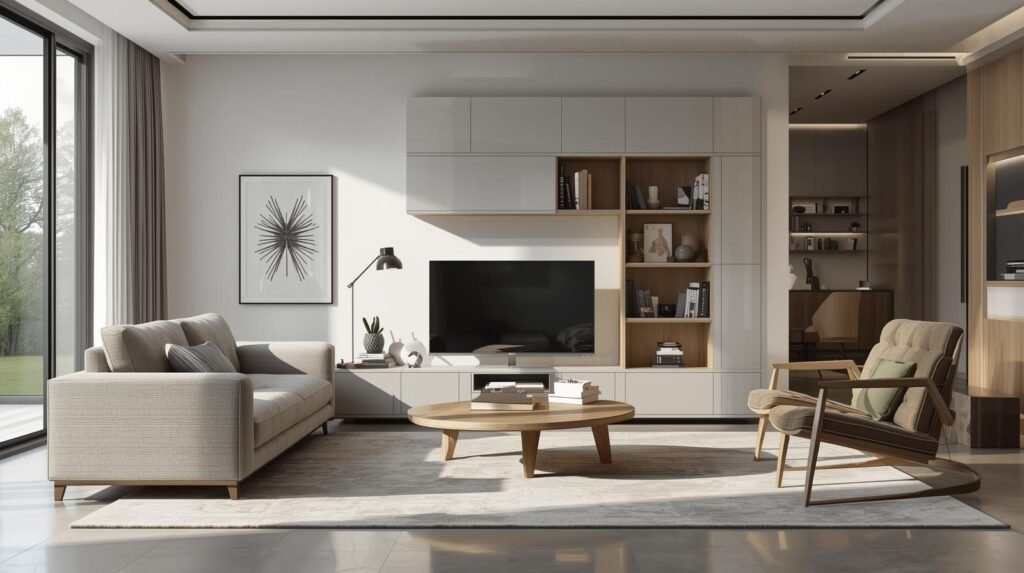
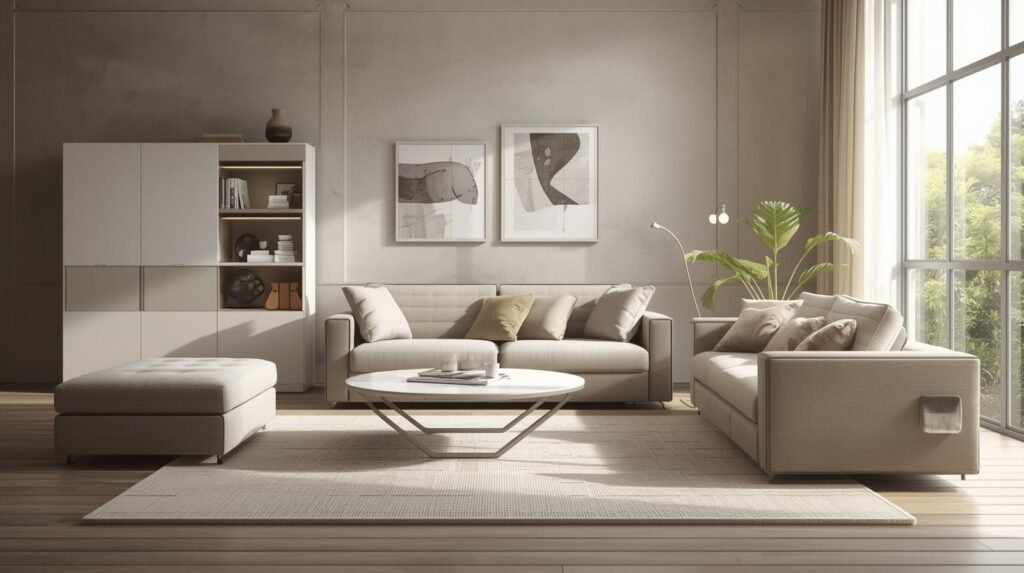
An upholstered storage ottoman doubles as a coffee table and extra seating — one of the most effective multifunctional pieces for a small living room on a budget.
Choose pieces in warm wood, rattan, or linen upholstery. Functional furniture doesn’t have to look utilitarian — the right material choices make dual-purpose items feel deliberately luxurious.
05 — Atmosphere
Layer Your Lighting — Don’t Rely on a Single Overhead
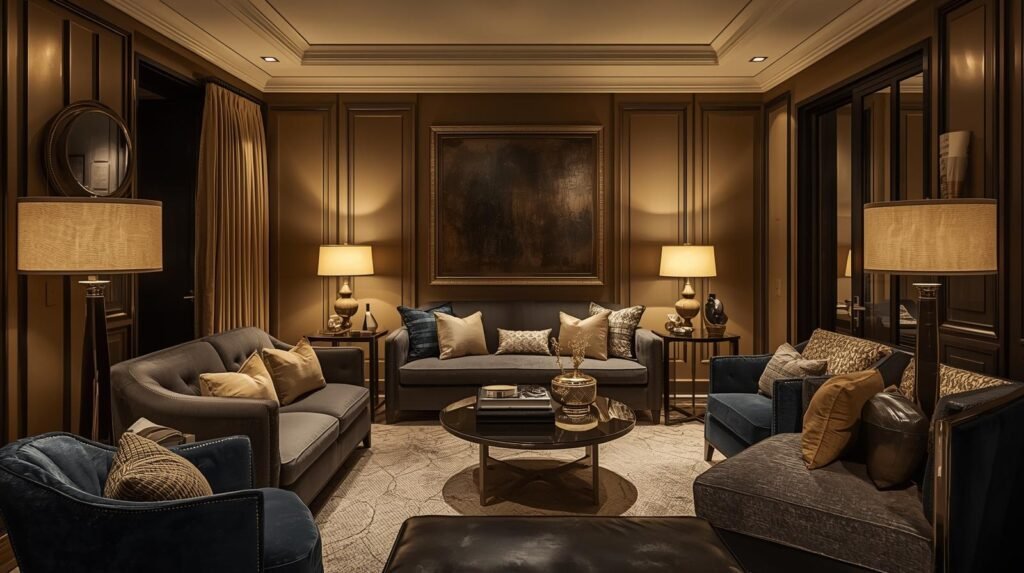
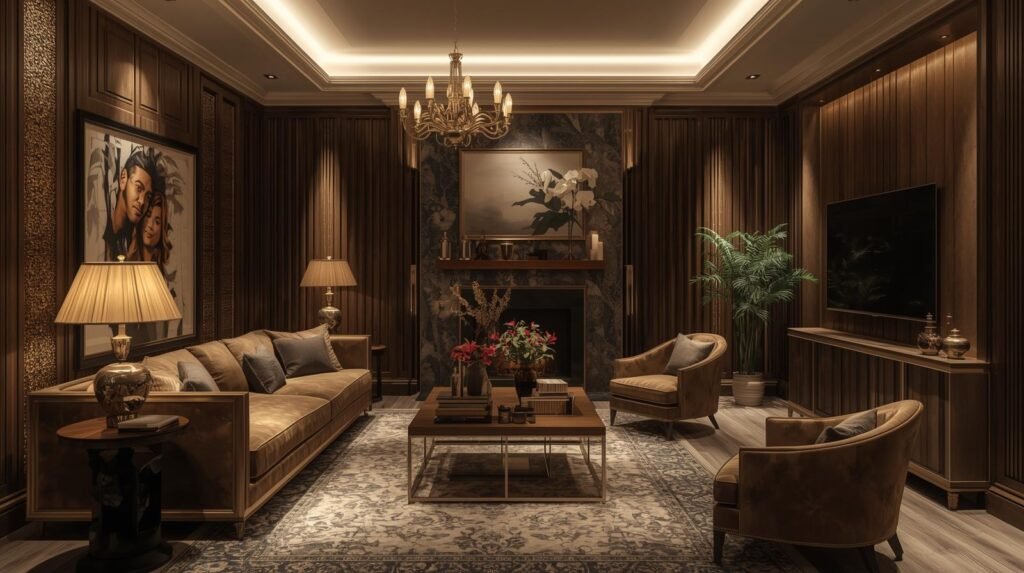
Nothing kills the look of a small apartment living room faster than a single harsh overhead light. Layered lighting is how interior designers create mood — and in a compact space, it’s even more critical because the layers create the illusion of depth and zones.
Ambient: Ceiling fixture or recessed lights at 2700–3000K • Task: Floor lamp beside the sofa or reading chair • Accent: Table lamp on a sideboard or console • Decorative: LED strip behind shelving or under furniture for a soft glow
A well-placed arc floor lamp in a small living room accomplishes something a ceiling pendant can’t — it creates a warm, intimate pool of light right where you need it, while also adding a vertical architectural element that draws the eye upward.
Always use warm LED bulbs at 2700K in a small living room. They make skin, wood, and textiles look their absolute best — and that warmth is what separates a room that looks expensive from one that looks flat.
06 — Height
Hang Floor-to-Ceiling Curtains
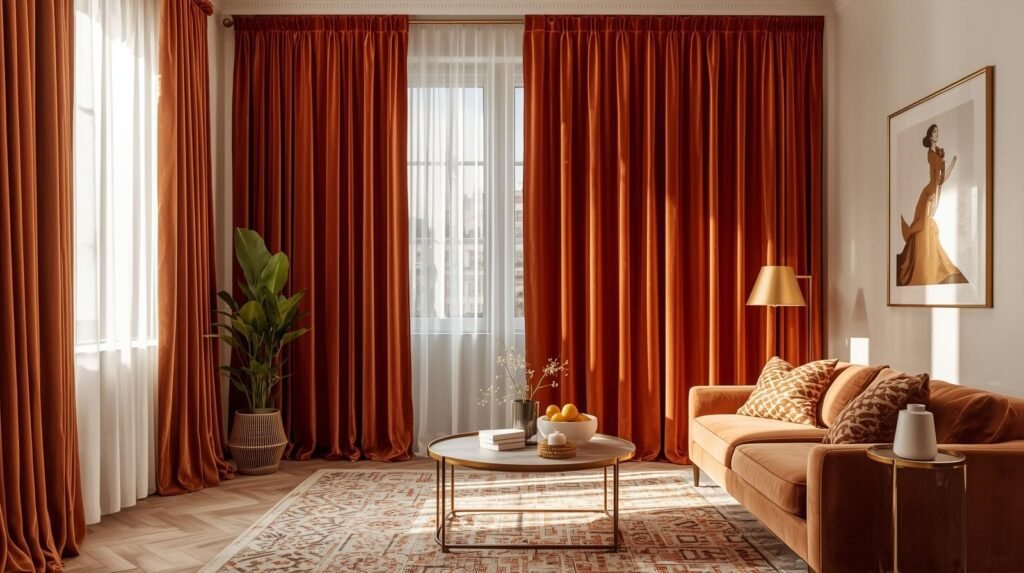
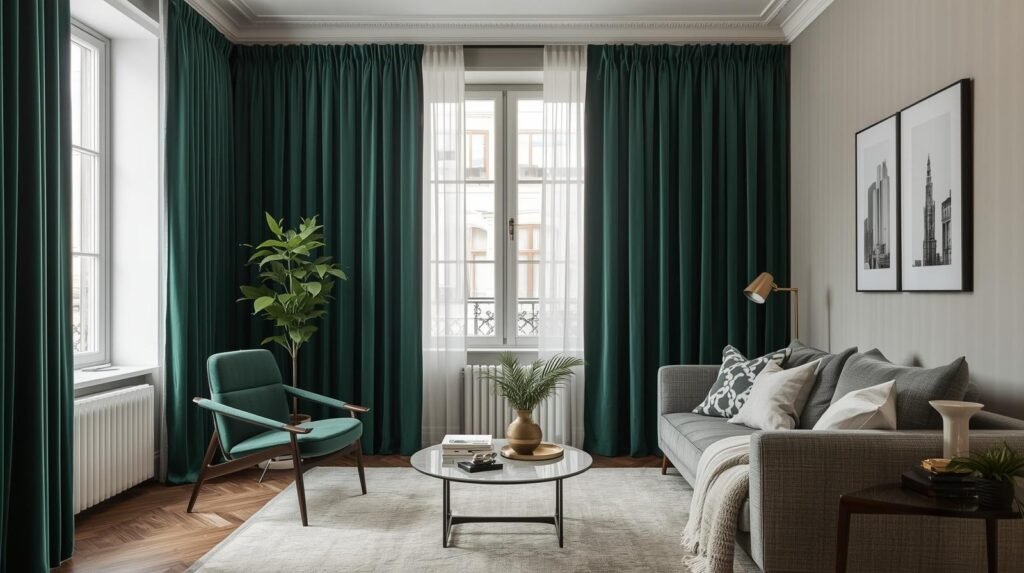
Hanging curtain rods high and wide — above and beyond the window frame — is one of the oldest designer tricks for making a small room feel grand.
This is one of the most effective and budget-friendly tricks for making a small apartment living room look expensive. Mount the curtain rod as close to the ceiling as possible — ideally within 4–6 inches of the crown molding — and let the curtains fall to the floor. This creates the visual impression of dramatically tall ceilings even if your ceiling is a standard 8 feet.
Also hang the rod wider than the window itself by at least 8–12 inches on each side. When the curtains are open, the window looks enormous. The room feels like something much larger than it is.
07 — Anchor
Use an Area Rug to Define the Space
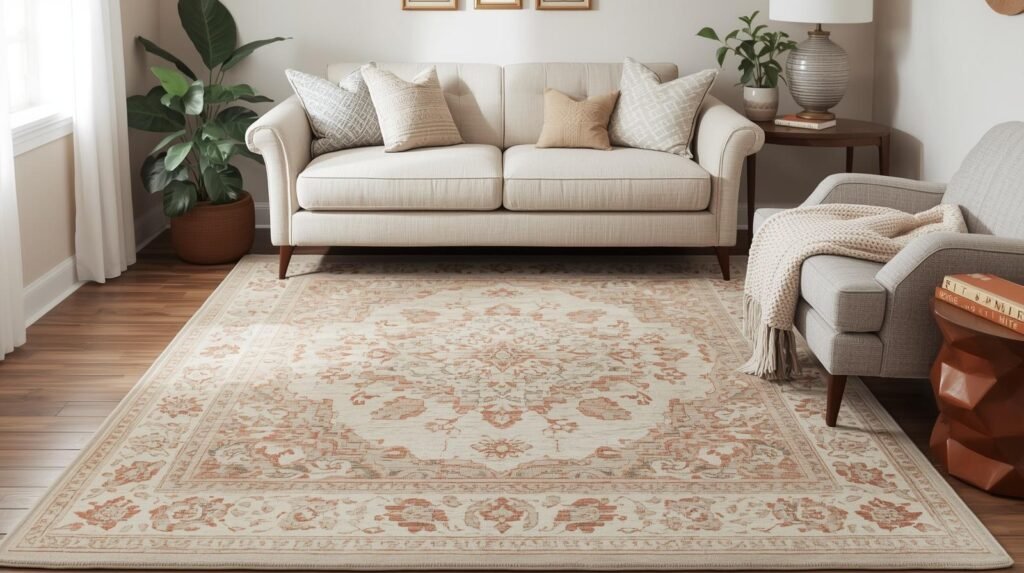
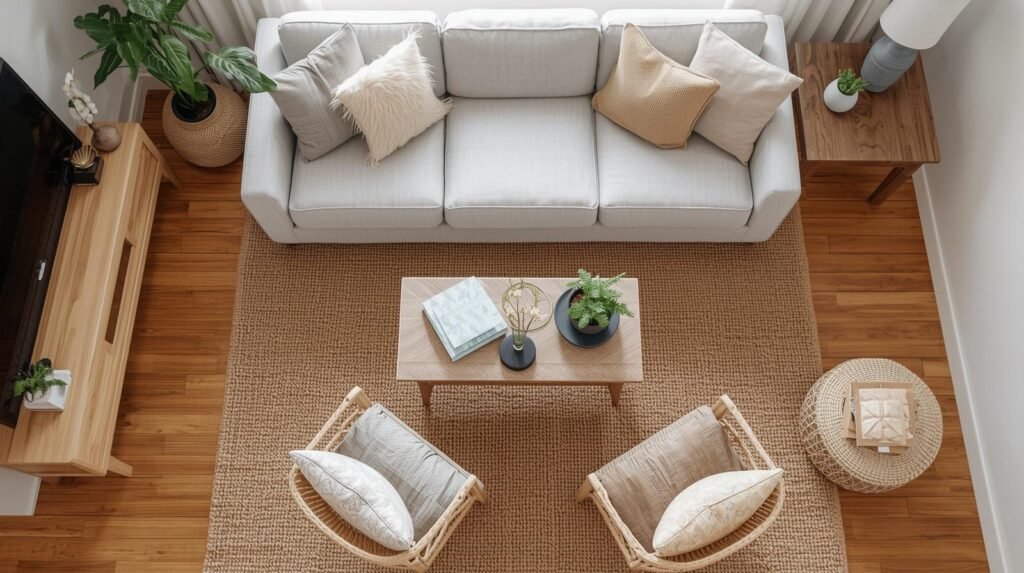
The most common mistake in small living rooms is buying a rug that’s too small. A correctly sized rug anchors all the furniture into a cohesive zone — like a room within a room. A too-small rug does the opposite: it makes the space look disjointed and oddly cheap.
For a standard small living room, the rug should be large enough that the front legs of every seating piece rest on it. At minimum, 8×10 feet. If you’re in a very tiny space, at least 6×9.
“A rug is the foundation of a living room — not an accessory. Get the size right, and the rest of the room follows.”
Choose low-pile rugs in warm neutrals or a subtle pattern. Jute, sisal, wool, or flatweave cotton all look considered without competing with the rest of the room. If you want pattern, go low-contrast — a tone-on-tone geometric or a muted vintage-inspired print.
08 — Focus Wall
Create a TV Wall That Looks Intentional
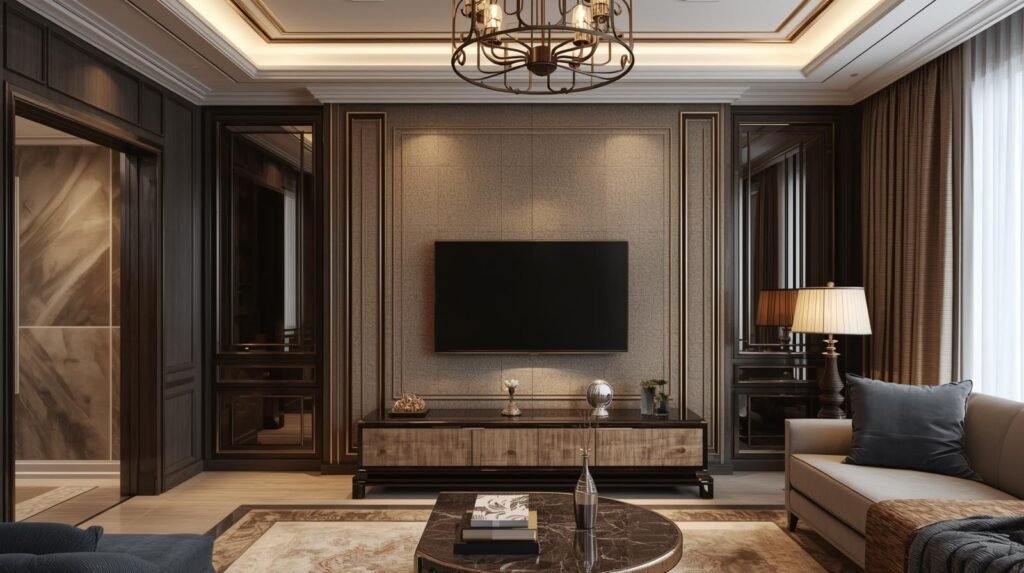
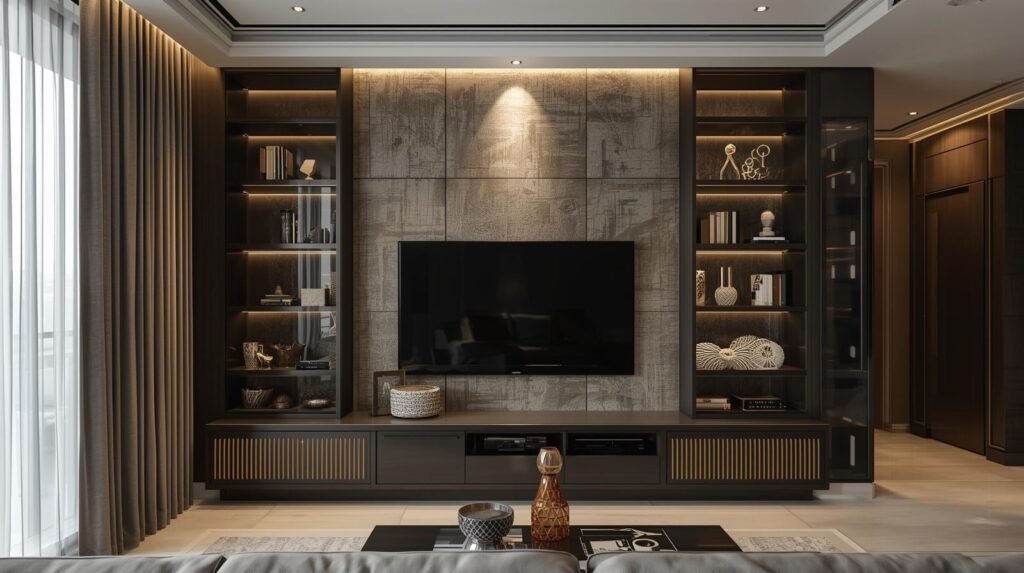
In a small living room with TV, the television is often the most dominant visual element — so the wall it sits on needs to earn its place. A bare TV on a cheap stand surrounded by nothing tells the story of a room that hasn’t been finished. Here are the approaches that genuinely elevate the look:
-
Wall-mount the TV: Removes the stand entirely and frees up floor space — immediately makes the room look cleaner and more expensive.
-
Flank with floating shelves: Frame the TV symmetrically with shelving. Style with books, plants, and a few curated objects.
-
Create a gallery wall around it: Art frames around a wall-mounted TV make the technology look intentional and integrated.
-
Use a low, sleek media console: Opt for one with doors to hide cable boxes and clutter. Warm wood finishes work best.
Paint the TV wall in a deep tone — charcoal, warm navy, or forest green. It creates a dramatic focal point in a small room, makes the TV disappear into the wall when off, and adds the kind of layered character that makes people assume the room was professionally designed.
09 — Illusion
Use Mirrors Strategically for Depth


A large arched or rectangular mirror on the main wall reflects light and duplicates the room — the fastest way to make a small space feel significantly larger.
Mirrors are the interior designer’s most reliable expansion tool. A large mirror — arched, rectangular, or a leaning full-length — placed opposite or beside a window doubles the natural light and literally reflects the room back at itself, creating an apparent depth that isn’t there.
For a small living room that looks expensive, skip the decorative cluster of small mirrors (too busy) and choose one large-format piece in a quality frame: antique brass, aged champagne, or warm wood. Position it to reflect the best part of the room — the window, the sofa, or the most styled corner.
10 — Life
Add Plants for Life and Instant Luxury

Plants are the most cost-effective luxury upgrade available for a small apartment. A single well-chosen plant does what no decorative object can — it introduces organic life, texture, and color that always looks curated. In a small living room, plants also add vertical interest and break the visual monotony of flat walls and furniture edges.
The best plants for small apartment living rooms:
Place one large plant in a corner to borrow height from the ceiling, and one trailing plant on a shelf or stool beside the sofa. Use high-quality ceramic or terracotta pots — the pot matters as much as the plant.
11 — Vertical Space
Floating Shelves Done the Right Way


Floating shelves styled with a mix of books, plants, art, and objects — always odd numbers, always breathing room between items.
Floating shelves solve a critical challenge in a small apartment: where to put things without eating floor space. Mounted correctly, they draw the eye upward, add significant storage, and give you a canvas to express personality.
The rule for shelves that look expensive: never overcrowd. Each shelf needs negative space — empty areas that let the other objects breathe. The formula that works: stack books horizontally in groups of 3, add one plant, one art object, one sculptural piece. Repeat. Leave 20–30% of shelf space genuinely empty.
“Shelves that look expensive aren’t full — they’re edited. The objects on them deserve to be seen, not just stored.”
12 — Dimension
Layer Textures to Add Depth

In any small apartment living room that looks expensive, texture is doing most of the work. When everything is the same flat material — think: smooth sofa, smooth walls, smooth coffee table — even a large room looks cheap. The solution is deliberately layering contrasting tactile surfaces throughout the room.
The goal is to mix at minimum 3–4 different material textures. They should all stay within the same warm palette — but feel completely different to the touch. This is exactly what separates a Pinterest-worthy small living room from a generic one.
13 — Centerpiece
Style Your Coffee Table Like a Designer

The coffee table is the most-looked-at surface in the living room. In a small apartment, how it’s styled makes a disproportionate impression. The approach that always looks expensive:
-
Use a tray to anchor objects: A round or rectangular tray keeps loose items contained and intentional — an instant upgrade from casual to curated.
-
Stack 2–3 books horizontally: Coffee table books with beautiful spines add color, height, and personality.
-
Add one organic element: A small plant, a dried floral stem in a bud vase, or a smooth stone that came from the natural world.
-
Leave 40% of the surface clear: Negative space is a luxury. An overcrowded coffee table looks cluttered — an edited one looks intentional.
In a small living room, a glass coffee table is almost always a win — it visually disappears and keeps the floor visible, which makes the room feel larger. Alternatively, a round table avoids sharp corners that interrupt flow in tight spaces. Learn more about marble coffee table styling for small spaces.
14 — Character
Hang Statement Wall Art


One large-format piece of art is almost always more impactful than a cluster of small prints. Left: oversized art on a neutral wall. Right: a tightly curated gallery wall.
Art transforms a small living room from “furnished” to “designed.” The approach that looks most expensive: one large, oversized piece of art on the primary wall. Not a collection of small prints scattered around — one dominant piece that commands attention.
This works because in a small room, large-format art draws the eye to the wall rather than the dimensions of the room. It becomes the visual story of the space, and everything else plays a supporting role. Frame in simple black, warm wood, or champagne gold for the most elevated effect.
If you prefer a gallery wall, keep the frames in a consistent finish and the spacing tight — no more than 2 inches between frames — and use a consistent mat color throughout.
15 — Edit
Edit, Declutter, and Let the Room Breathe

This is the most important of all 15 ideas — and the one that costs nothing. Luxury doesn’t mean more. It means exactly the right amount. Every small living room that looks expensive has been ruthlessly edited. There are no extra chairs no one sits in, no side tables covered in objects, no stacks of things on the floor, and no visible cords.
Go through every surface and ask: does this earn its place? If it doesn’t serve a clear visual or practical function, it shouldn’t be there. What remains should be intentional, considered, and beautiful in its own right.
For any flat surface in a small living room — coffee table, sideboard, shelves — limit to 5 objects maximum. Then remove two more. What’s left will look curated, not cluttered.
Hide cables with cord covers, cable management boxes, or furniture placement. Tuck remotes inside the ottoman. Clear the floor of everything that doesn’t belong there. The result is a small room that feels genuinely calm, considered, and expensive — at any budget.
Common Small Living Room Mistakes to Avoid
Even with the best intentions, these are the pitfalls that make a small apartment living room look smaller, cheaper, and less considered:
-
Too-small rug: The number one mistake in small living rooms. It disconnects the furniture and makes the space look unfinished. Always size up.
-
Curtains hung at window height: This caps the room and makes windows look small. Always hang high — at ceiling height — and wide.
-
Furniture pushed to the walls: It creates an awkward floating emptiness in the centre and a cramped perimeter. Float the furniture inward.
-
Too many competing patterns: In a small room, pattern clutter reads as chaos. Stick to one or two patterns at most, and let texture carry the rest.
-
Cold white lighting: 5000K bulbs make a small room feel like a hospital. Always use warm LEDs at 2700–3000K and layer multiple sources.
-
Overcrowded surfaces: A small living room on a budget can look expensive — but not if every surface is covered. Edit everything to a minimum.
Frequently Asked Questions
How do you make a small apartment living room look expensive on a budget?
The most budget-friendly upgrades are: repainting in a warm neutral tone, hanging curtains high and wide, adding a correctly-sized area rug, layering warm lighting, and ruthlessly decluttering. These changes alone transform any small living room without significant spending.
What is the best color for a small apartment living room?
Warm neutrals work best: warm white, linen, greige, cream, and soft taupe. These tones visually expand the space because the eye reads them as continuous rather than stopping sharply at contrasting walls. Avoid cool whites and blues — they make small rooms feel cold and boxy.
What size rug should I use in a small living room?
At minimum, 6×9 feet — and 8×10 is almost always better than you’d think. The rule of thumb: the front legs of every seating piece should rest on the rug. If the rug is too small, furniture feels disconnected. When in doubt, size up.
How do I arrange furniture in a very small living room?
Float the sofa away from the wall — even just 4–6 inches creates breathing room. Place the coffee table central with 18 inches of clearance. Position one accent chair at a slight angle to the sofa. Keep traffic paths 30–36 inches clear. Don’t block windows with furniture.
What is the best type of sofa for a small living room?
Look for a sofa with a low-to-mid height back, exposed or tapered legs (so the floor is visible underneath), a compact 34–36 inch seat depth, and neutral upholstery. In very small rooms, a loveseat plus an accent chair often works better than a full three-seater.
How do I style a small living room with a TV without it looking cluttered?
Wall-mount the TV to remove the stand and free up floor space. Frame it with floating shelves styled with books, plants, and objects in odd numbers. Alternatively, paint the TV wall a deep accent color to integrate the television into the design. A low, streamlined media console with concealed storage keeps everything else tidy.