
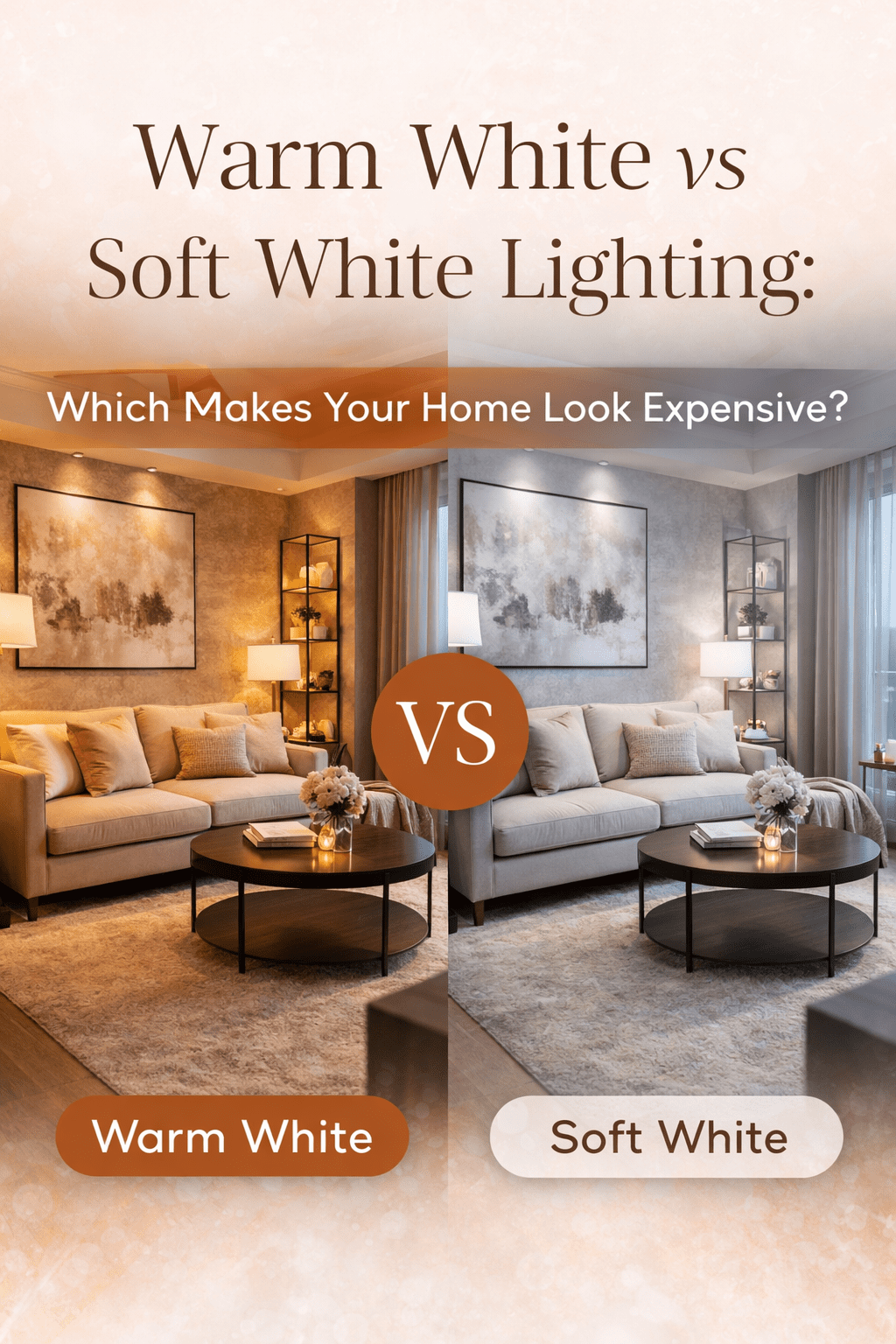
Lighting is often called the “silent decorator”—and for good reason. You can invest in premium materials like marble, wood, or velvet, but the wrong lighting temperature can instantly downgrade your space.
In modern interior design, lighting temperature (Kelvin) is one of the most critical factors influencing whether a home feels luxurious or cheap. The debate between warm white vs. soft white lighting is no longer just technical—it’s psychological.
01 — The Science
Decoding the Kelvin Scale: Warm vs. Soft White
To understand which light makes your home look more expensive, we must first look at the Kelvin (K) scale. This is the numerical measure of a light’s color temperature.
Oddly, “Soft White” is actually warmer (yellower) than “Warm White” in most retail brands. Traditionally, 2700K is Soft White and 3000K is Warm White. While a 300K difference seems small, it completely changes how your textures—like marble, metals, and wood—are perceived.
02 — The Secret
The Designer Choice: Why 2700K Looks More “Expensive”
Luxury is about warmth and intimacy. High-end residential designers gravitate toward 2700K because it mimics the incandescent glow of traditional bulbs. This temperature provides a “sunset effect” that softens the lines of a room and creates a layered, sophisticated atmosphere.
“Expensive design isn’t just about what you see; it’s about how the space feels. A 2700K glow makes a room feel like a sanctuary, not a laboratory.”

When you use 3000K or 4000K in a living room, the light can feel “flat.” It reveals every flaw and gives the space an energetic, buzzy feel that contradicts the “Quiet Luxury” aesthetic. If you want the “Old Money” or “European Boutique” vibe, 2700K is your gold standard.
03 — Fidelity
The “Hidden” CRI Factor: Why High-End Homes Pop
If you’ve ever bought a light bulb and felt the room looked “muddy” even at the right temperature, you likely missed the Color Rendering Index (CRI). CRI measures how accurately a bulb reveals colors. For a home to look expensive, you need a CRI of 90 or above.

Low CRI bulbs (usually cheap LEDs found in big-box stores) make your expensive fabrics look desaturated. A high-CRI 2700K bulb will make a light grey sofa look rich and textured, whereas a low-CRI bulb will make it look flat and cheap.
04 — Placement
Room-by-Room Breakdown: When to Use Soft vs. Warm
While 2700K is the ruler of luxury living, there are times when 3000K (Warm White) is the better choice for productivity and functional areas.

1. The Living Room & Bedroom (2700K)
This is where “Quiet Luxury” lives. Use dimmable 2700K bulbs in all ambient sources (chandeliers and recessed lights) and accent sources (sconces). This creates the warm, layered lighting commonly found in five-star hotels.
2. The Kitchen & Bathroom (3000K)
In the kitchen, you need more clarity for tasks. A 3000K bulb provides a crisp, clean white that makes marble countertops look brilliant and white cabinetry look “true” without feeling cold. In bathrooms, 3000K is better for grooming as it reveals more detail than 2700K.
05 — Pitfalls
5 Common Lighting Mistakes That Make Homes Look Cheap

-
Mixing Temperatures: Having a 2700K lamp in the same room as a 4000K overhead light creates visual chaos.
-
Under-lighting: Relying on a single, harsh overhead source instead of 3 to 5 layered pockets of light.
-
Neglecting Dimmers: If your lights cannot dim, they cannot be luxurious. Dimming is the ultimate tool for mood control.
-
Using “Daylight” Bulbs (5000K+): Unless you are running a sterile workspace or surgery center, keep daylight bulbs out of your residential living spaces.
-
Exposed Bulbs: Glare is the enemy of expensive design. Always use shades or recessed fixtures to hide the physical bulb source.
Always use warm LED bulbs at 2700K in relaxation spaces. They make skin tones, rich wood grains, and luxury textiles look their absolute best. This ambient warmth is the single most important factor that separates an expensive-looking room from one that feels flat and sterile.
06 — FAQ
Frequently Asked Questions
What is the best Kelvin for an expensive living room?
2700K Soft White is the industry standard for high-end living rooms. It provides the warmest, most inviting glow that mimics high-end hospitality design.
Can I mix 2700K and 3000K in the same house?
Yes, but not in the same room. Use 2700K for “relaxation zones” like bedrooms and living rooms, and 3000K for “working zones” like kitchens and pantries.
Why does 2700K look better on dark wood?
Warmer light temperatures enhance the red and brown undertones in wood, making the grain look deeper and more expensive. Cooler light can make rich wood look gray and dusty.